
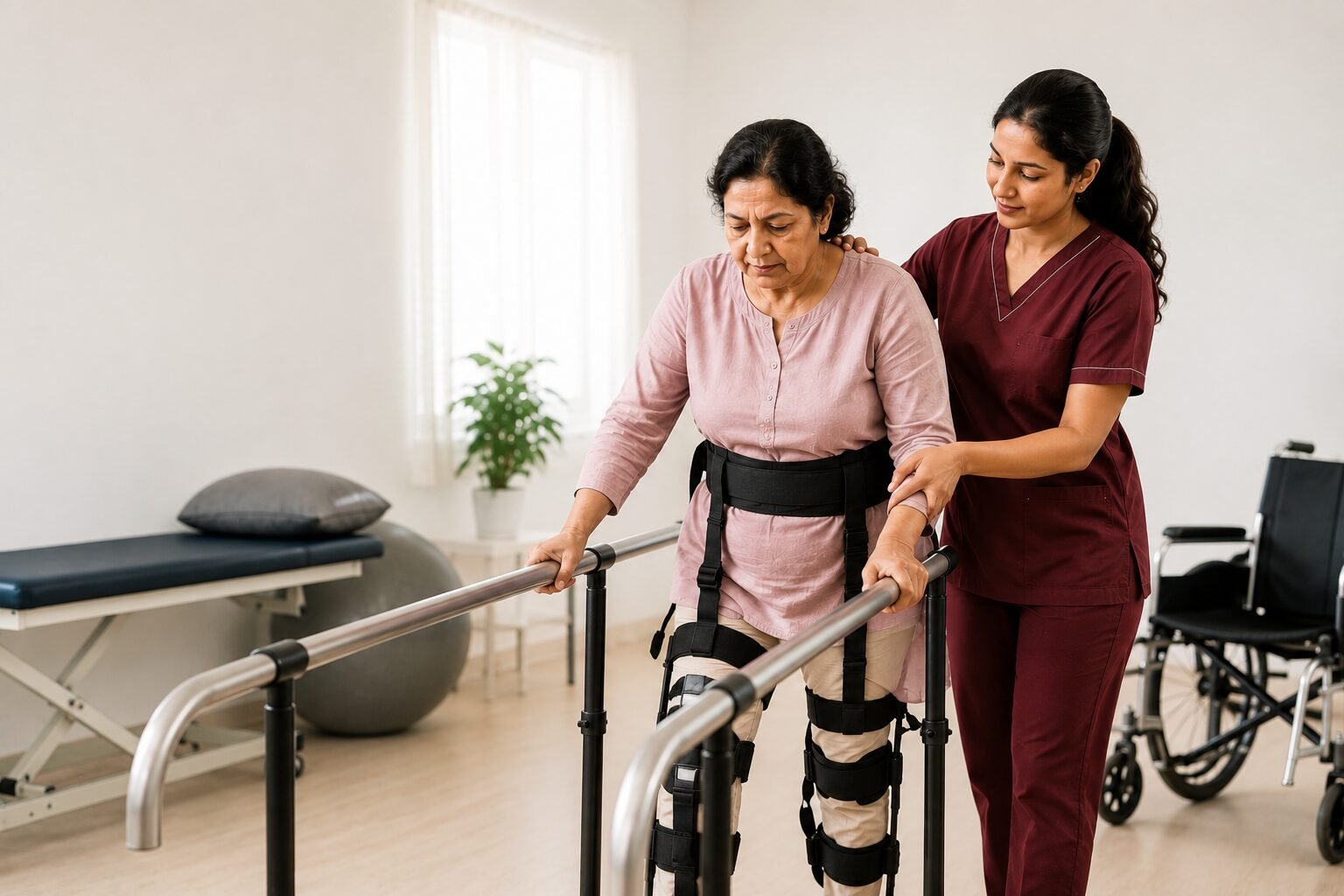
A stroke can change the way a person uses their hand. Picking up a cup, buttoning a shirt, holding a spoon, turning a key, or even opening the fingers may suddenly become difficult. For some stroke survivors, the hand feels weak and heavy. Others may experience stiffness, reduced sensation, poor coordination, or difficulty controlling individual fingers.
Because the hand plays such an important role in everyday activities, restoring useful hand movement is an important part of stroke rehabilitation. However, recovery is not simply about repeatedly squeezing a ball or strengthening the fingers. Effective hand rehabilitation after stroke focuses on movement control, coordination, sensation, strength, and the ability to use the hand during meaningful tasks.
Why Does Hand Function Change After a Stroke?
Hand movement depends on communication between the brain, spinal cord, nerves, and muscles. A stroke can disrupt the brain areas and pathways responsible for controlling the affected side of the body.
As a result, a person may experience:
- Reduced hand and finger strength
- Difficulty opening or closing the hand
- Trouble moving individual fingers
- Poor grip or release
- Reduced coordination
- Stiffness or increased muscle tone
- Changes in sensation
- Difficulty judging the position of the hand
- Fatigue during hand activities
The severity of these problems varies depending on the location and extent of the stroke.
What Does Hand Weakness After Stroke Look Like?
Hand weakness after stroke does not always mean that the person cannot move their fingers at all.
A stroke survivor may be able to close the hand but struggle to open it again. Someone else may be able to lift a finger but have difficulty coordinating several fingers together.
Common everyday difficulties include:
- Holding a glass securely
- Picking up small objects
- Using a mobile phone
- Writing
- Eating independently
- Turning pages
- Handling clothing fasteners
- Using keys
- Brushing teeth
- Opening containers
These seemingly simple tasks require a combination of strength, precision, timing, sensation, and coordination.
Why Is Hand Rehabilitation Important After Stroke?
The hand is involved in many activities that contribute to independence. Improving its function can therefore have practical benefits beyond exercise performance.
Hand rehabilitation after stroke aims to help a person regain as much useful movement as possible and learn safer ways to complete daily activities.
Rehabilitation may focus on:
- Finger movement
- Wrist control
- Grasping
- Releasing objects
- Hand-eye coordination
- Bilateral hand use
- Fine motor skills
- Sensory awareness
- Functional independence
The appropriate programme depends on the person’s current ability.
Hand Exercises After Stroke: Where Should You Start?
Exercises should be selected according to the individual’s movement and medical condition. A person with some active finger movement may require a very different programme from someone who cannot voluntarily move the hand.
Some commonly used rehabilitation activities include the following.
1. Finger Opening and Closing
If the person can actively move the fingers, they may practise slowly opening and closing the hand.
The movement should be controlled rather than rushed.
This can help practise the basic pattern of gripping and releasing.
2. Individual Finger Movement
A therapist may ask the person to move one finger at a time.
This is more challenging than simply making a fist because it requires greater control and coordination.
For example, the person may practise:
- Lifting one finger
- Touching the thumb to each fingertip
- Separating the fingers
- Slowly straightening the fingers
The exercise should be adapted if stiffness or pain is present.
3. Thumb-to-Finger Touch
Touching the thumb to each fingertip can help practise precision and coordination.
The person may work through:
Thumb → index finger → middle finger → ring finger → little finger
Initially, movements may be slow or inaccurate. The aim is controlled practice rather than speed.
4. Supported Wrist Movement
Hand function also depends on wrist control.
Under professional guidance, a person may practise gently moving the wrist up, down, and from side to side.
Good wrist positioning can make grasping and releasing objects easier.
5. Picking Up Lightweight Objects
Functional practice can make hand exercises after stroke more meaningful.
Depending on ability, a person may practise picking up safe, lightweight objects such as:
- Soft blocks
- Cups
- Large pegs
- Towels
- Lightweight containers
The focus can gradually shift from simply moving the hand to completing a useful task.
6. Grasp-and-Release Practice
Holding an object is only part of hand function. Being able to release it at the right time is equally important.
A therapist may introduce activities where the person picks up an object, moves it to another location, and deliberately releases it.
This helps practise the complete movement sequence.
How Can Grip Strength After Stroke Be Improved?
Grip strength after stroke should not be treated as the only measure of hand recovery.
A person may have reasonable squeezing strength but still struggle to open the hand, manipulate an object, or coordinate the fingers.
Where strengthening is appropriate, rehabilitation may involve graded resistance exercises using suitable equipment or everyday objects.
The amount of resistance should be determined according to the person’s ability. Excessive resistance may encourage poor movement patterns or increase fatigue.
The goal is useful strength combined with control, not simply producing the strongest possible grip.
What If the Fingers Are Stiff or Difficult to Open?
Some stroke survivors develop increased muscle tone or spasticity. The fingers may remain curled, and opening the hand may become difficult.
In this situation, repeatedly forcing the fingers open is not a suitable solution.
A rehabilitation professional can assess:
- Muscle tone
- Joint flexibility
- Pain
- Hand positioning
- Skin condition
- Functional movement
Management may include positioning, appropriate movement exercises, stretching, splinting when indicated, functional practice, and medical treatment where necessary.
Can Sensation Affect Hand Function?
Yes.
A person may have reduced or altered sensation after a stroke. They may not clearly feel whether an object is hot, cold, heavy, light, rough, or smooth.
Changes in sensation can make it harder to control the hand and may increase the risk of accidentally dropping or mishandling objects.
Rehabilitation may therefore include sensory activities alongside movement practice when appropriate.
Why Task-Based Training Matters
One of the most useful principles in rehabilitation is practising movements that relate to real-life activities.
Instead of focusing exclusively on isolated exercises, therapy may incorporate tasks such as:
- Holding a spoon
- Picking up a cup
- Folding a towel
- Handling clothing
- Opening and closing containers
- Using both hands together
- Reaching for objects
This approach connects physical movement with the skills the person actually needs in daily life.
Improving Hand Function After Stroke: Think Beyond Grip
Improving hand function after stroke involves several abilities working together.
For example, picking up a cup requires:
- Seeing and locating the cup
- Reaching toward it
- Positioning the wrist
- Opening the fingers
- Grasping the cup
- Maintaining the appropriate amount of pressure
- Lifting it
- Moving it safely
- Releasing it
A rehabilitation programme may therefore address the complete sequence rather than focusing only on finger strength.
Can Both Hands Be Used During Rehabilitation?
In many situations, yes.
Activities that require both hands can encourage the affected hand to participate in meaningful movements.
For example, a person may practise:
- Holding a towel with both hands
- Folding clothes
- Carrying a lightweight object with both hands
- Stabilising an object with one hand while manipulating it with the other
The therapist should determine whether a particular task is appropriate and how much assistance is required.
How Often Should Hand Exercises Be Done?
There is no single exercise frequency suitable for every stroke survivor.
The amount of practice depends on:
- Stroke severity
- Current hand movement
- Fatigue
- Pain
- Muscle tone
- Other medical conditions
- Stage of recovery
- Overall rehabilitation programme
Short, well-controlled practice may be more useful than continuing an exercise after the person becomes excessively tired.
Consistency is generally more important than performing large numbers of repetitions without proper technique.
What Should Families Avoid?
Caregivers often want to help, but certain approaches can unintentionally make rehabilitation more difficult.
Avoid:
- Forcing stiff fingers open
- Pulling the affected arm or hand
- Using heavy resistance without professional guidance
- Continuing an exercise despite pain
- Assuming that squeezing exercises are appropriate for everyone
- Comparing one person’s recovery speed with another’s
- Doing every task for the stroke survivor when they can safely participate
The aim should be to provide the right amount of assistance, allowing the person to participate as actively as their abilities permit.
When Should a Therapist Assess the Hand?
A professional assessment is particularly useful when hand movement is significantly restricted, stiffness is increasing, pain develops, or everyday activities are becoming more difficult.
A physiotherapist or occupational therapist can identify the person’s specific limitations and determine which exercises and functional activities are appropriate.
Occupational therapy can be especially valuable when the main goal is to improve the practical use of the hand during dressing, eating, grooming, writing, and other daily activities.
How Antara Supports Upper-Limb Rehabilitation After Stroke
Hand recovery often forms part of a larger rehabilitation programme. A person may simultaneously need support for walking, balance, speech, swallowing, cognition, or activities of daily living.
At Antara Care Homes, stroke rehabilitation can involve a multidisciplinary team of doctors, nurses, physiotherapists, occupational therapists, speech therapists, and personal health assistants. Depending on individual needs, rehabilitation may include daily physiotherapy, occupational therapy, gait and mobility training, speech and swallowing therapy, medication management, nutrition support, and clinical monitoring.
The programme is tailored around the person’s functional abilities and recovery goals. Rather than treating hand movement separately from the rest of rehabilitation, therapy can work toward improving participation in everyday activities and greater independence.
Conclusion
Hand rehabilitation after stroke is about more than strengthening the fingers. A person’s ability to use their hand depends on coordination, sensation, wrist and finger control, muscle strength, and the ability to translate these movements into everyday tasks.
Appropriate hand exercises after stroke, combined with task-specific practice and professional rehabilitation, can help stroke survivors work toward better hand control and greater independence. Progress may be gradual, and small functional improvements—such as holding a cup, releasing an object, or using both hands together—can represent meaningful steps forward.
The most effective programme is one that is individualised, safe, progressive, and connected to the activities the person wants and needs to do in daily life.